

Procrusteanism
How Gary Stevenson's Obsession with Equality Cuts Britain's Capital Down to Size

Written by our Managing Editor Elias Sanchez
Since Starmer’s resignation, a series of economic events have followed one after another in Britain. Andy Burnham is regarded, by all due reckoning, as the potential saviour of the Labour Party in the United Kingdom. But this belief, on due reckoning, is refutable, because that party’s ideas for the United Kingdom have proved disastrous in real terms. By attacking Labour, it is far from my aim to defend the Conservative Party either, because they too were the architects of the catastrophe, in real terms, in the quality of life British people have suffered since 2008. This owes to the fact that they deferred to political correctness and were far too polite towards those who are enemies of a free and open society, by due reckoning. A political analysis of the parties of the day in the United Kingdom is a matter aside from this economic opinion piece.
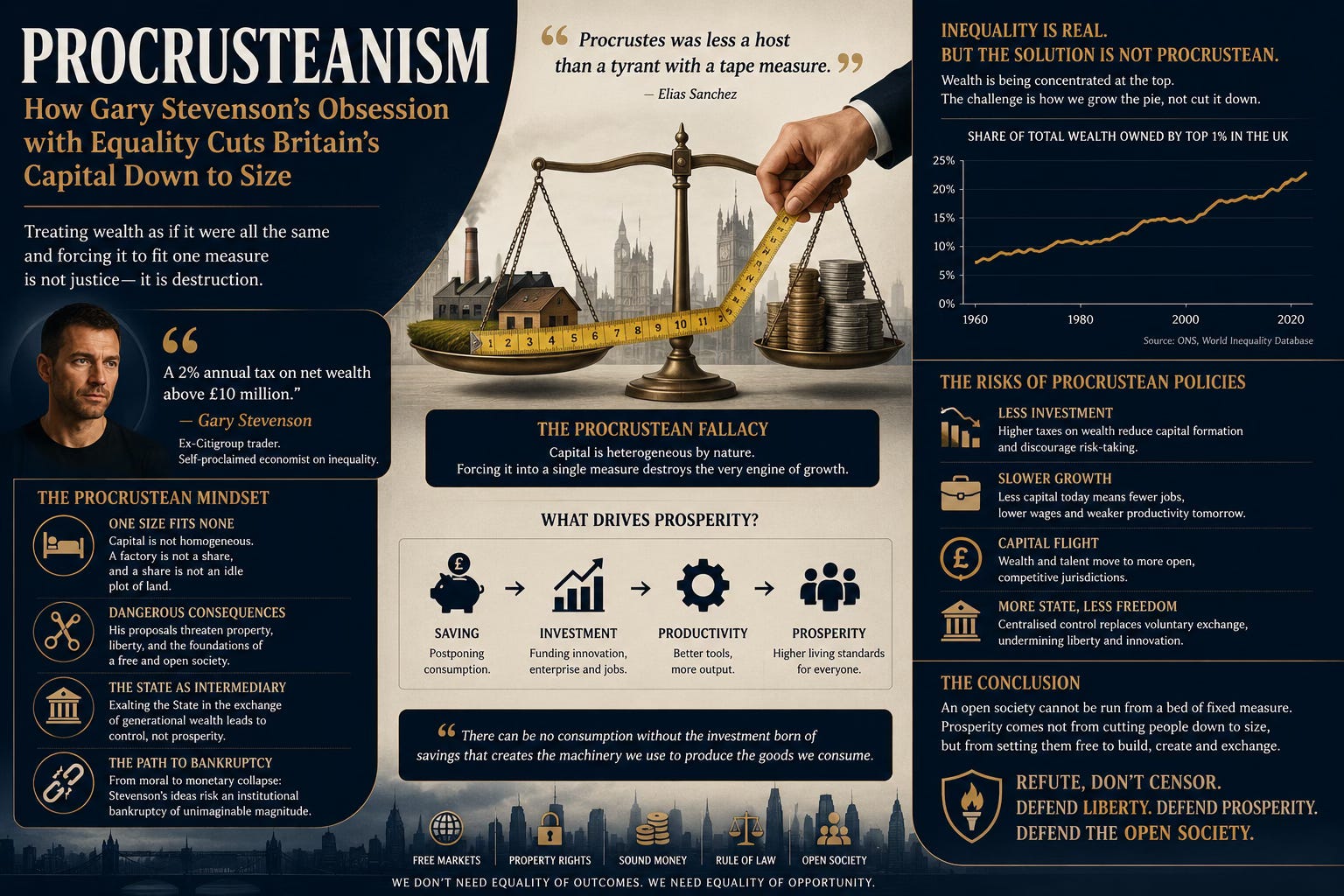
Otherwise, this opinion piece concerns a character who has appeared on most British channels over the last couple of days. That character’s name is Gary Stevenson, who proclaims himself, by due reckoning and depending on the interview of the moment, as “the most profitable trader” Citibank — a consumer and commercial bank — ever had in its history, and on other occasions, as the most accomplished “inequality economist of his generation” — a repetitive insistence that, by several accounts, has already made more than one interlocutor with genuine technical credentials rather uncomfortable. Whether these claims are true in absolute terms is another matter of comparative conversation. There are interesting ideas in this character; one of them, one might say, derives from the perspective of thinkers such as Piketty: that wealth is being systematically transferred away from the middle classes and the government towards a small super-rich elite. And, therefore, the social solution is a “2% annual tax on net wealth above £10 million”; a threshold that would not touch Stevenson’s own fortune, who told Piers Morgan’s channel he holds £5 million net.
Without dwelling on the minor upsets this character has been having across various channels, I should like to apply a neologism which, by due reckoning, I used in one of my opinion columns for the Bolivian digital newspaper Brújula Directa: the mythological concept of “Procrusteanism.” And, in neologistic terms, I should like to apply this to Stevenson as the twenty-first-century British Procrustes. Why Procrustes? Because the word and the obsession with “inequality” — which never leaves his vocabulary — is a clinging, leech-like obsession. Gary has a convulsive fixation on the term. Should there be demand for a technical analysis of Stevenson’s conjectures, I can produce a more precise and specific account of his ideas from the economic field, and of the fallacies harboured within his derivative argument, which stems from a labour-theory-of-value analysis long since abysmally defeated by the subjectivist school of value in the nineteenth century; but within this framework, what concerns me is setting out the philosophical and compulsive methodology of his madness for equality. And this can be understood simply through the mythological figure of Procrustes. Procrustes was so obsessed with equality that, although he was most hospitable in his home and offered his guests the finest service, with a bed of precise arithmetical measure (xyz centimetres), his obsession drove him to cut off his guests’ limbs while they slept, so as to fit them to that measure of bed. And here the irony becomes mythologically exact: in some versions of the tale, Procrustes possessed not one bed but two, one short and one long, and decided which to offer each guest according to what suited him, so as to guarantee the same outcome regardless of the traveller’s height. We could say that Procrustes, by today’s measures, was less a host than a tyrant with a tape measure.
But how can we perceive our British Procrustes nowadays by our political measures? Well, from one perspective, he can be perceived as a saviour of the most vulnerable, with good intentions. But from another, as the product of an intellectual hubris that believes it knows what is best for the “average person” in Britain. Think the former, and you might even consider having him replace Andy Burnham, even though he has never been an MP. Think the latter, and you might find yourself part of the intellectual resistance against such a figure. Following the latter perspective, the worst of his convulsive methodology, by every measure, sets him completely against the economic values and mores of an open and free society in which wealth is exchanged on voluntary terms. His proposals are violent and despotic, carrying inherent dangers to the principles of property and liberty, and exalting the figure of the State as an intermediary in the free exchange of generational wealth — which, in the last century, led to tremendous catastrophes against the life projects of millions of people. The key move in this debate is to refute, not to censor, and to make clear, from the perspective of those of us who cherish Popperian principles of an open and free society, that Gary Stevenson’s ideas will lead Britain to an institutional bankruptcy of unimaginable magnitude — ethical first, and economic thereafter.
What is Procrustean about Stevenson’s proposal, however, is not exhausted by the ten-million-pound threshold: it lies in a deeper methodological gesture, one that treats capital — which is by its nature heterogeneous; a factory is not a share, and a share is not an idle plot of land — as though it were a homogeneous mass, capable of being measured by a single ruler and cut to the size of an egalitarian ideal. Capital is the intertemporal postponement of consumption in favour of saving — though, from another perspective, it is equally the result of consumption. There can be no consumption without the investment born of savings that creates the machinery we use to produce the goods we consume. Procrustes did not distinguish between guests; Stevenson does not distinguish between forms of capital, nor between the dangers of central-bank monetary policy and those of a fractional-reserve banking system that draws no distinction between deposit and loan contracts and generates booms and busts of its own accord. That blindness is, in real terms, more dangerous than the simple failure of his tax to raise revenue — imagine taxing the very capital an economy needs in order to grow. This is the pretence that an open society could be administered from a bed of fixed measure, adjusted, each time, to whatever dimensions suit Britain’s own Procrustes.
Tired of surface-level mainstream narratives? Get sharp, unfiltered geopolitical and macroeconomic analysis delivered straight to your inbox. Subscribe to The Strategic Desk today and never miss a breakdown.